THE UNCOMFORTABLE TRUTH OF AMUSEMENT: HOW ARE WE DESTROYING OUR FREEDOM IN THE NAME OF ENTERTAINMENT?
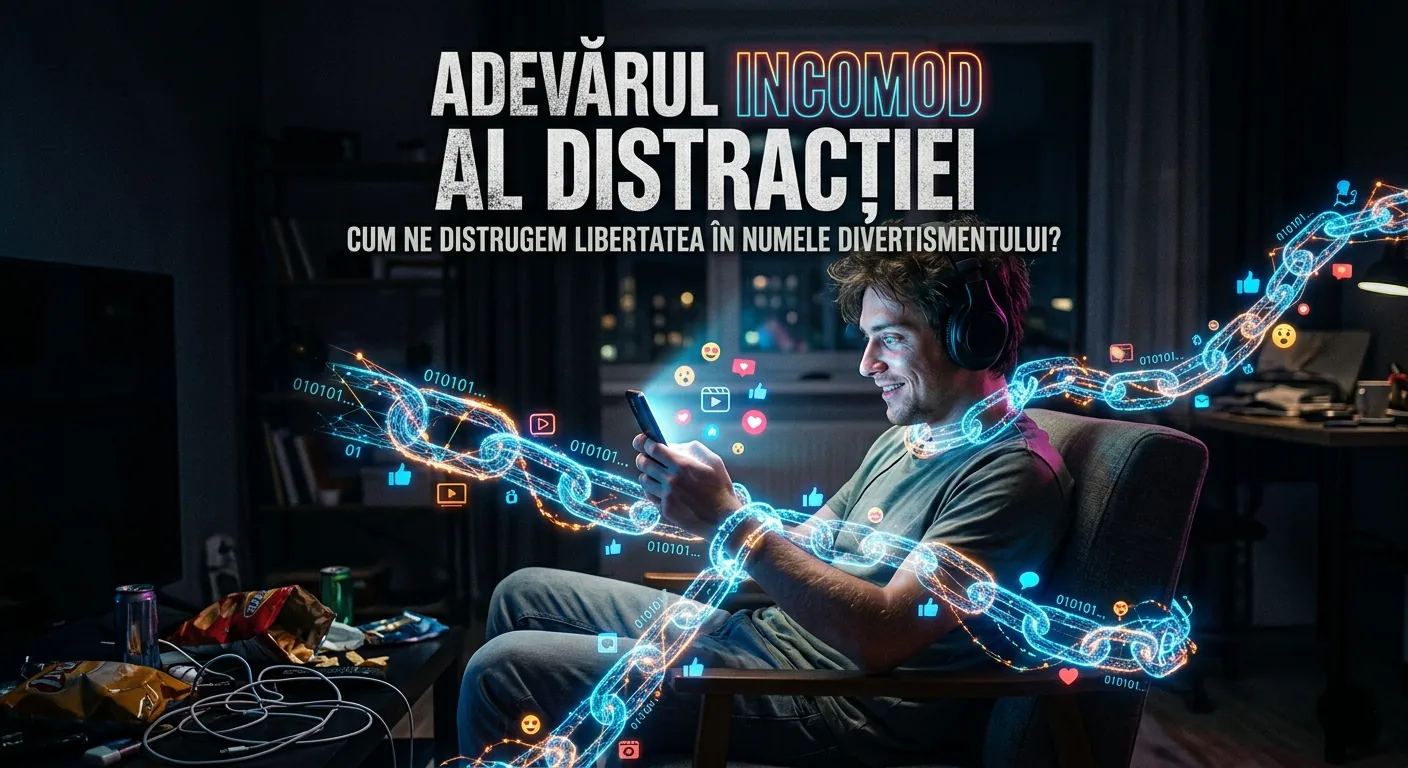
Why does a completely connected society—one that never stops laughing, scrolling, and gaming—become the easiest to control? Behind the algorithms delivering minute-by-minute happiness lies a subtle mechanism designed to numb the collective consciousness.
By: Special Correspondent, May 2026
We are living in the golden age of availability. Just a screen tap away, we have access to more audio-visual, interactive, and social content than a thousand future generations could ever consume. Streaming platforms predict our moods, games grant instant rewards for every micro-action, and social networks have transformed reality into an endless feed of short clips, perfectly optimized to keep our eyes glued to the glass.
Apparently, we are freer and more entertained than ever before. But what if this constant “entertainment” is not a prize of technological progress, but a refined, invisible form of control?
The Sleep of Reason Breeds… Entertainment
Aldous Huxley warned in his famous dystopia “Brave New World” that the public would eventually come to love their oppression—not through force and terror, but through an addiction to pleasure and comfort. Unlike the Orwellian scenario of control through fear, the reality of 2026 looks much more like a smiling numbness.
Every notification, every “Level Up,” and every neuronal optimization algorithm integrated into modern platforms acts as an anesthetic. When the brain receives a continuous, cheap dose of dopamine, the capacity for deep attention collapses. The ability to read a long text, analyze a complex document, or question a decision made by an authority or a massive tech corporation becomes too much of an effort.
Constant entertainment keeps us busy. It keeps us tired, yet satisfied. A public trapped in its own entertainment bubble is a public incapable of focusing on real issues: the erosion of digital rights, the centralization of personal data, or the mysterious disappearance of people who tried to think outside the network.
The Illusion of Choice and the Death of Critical Thinking
“You choose what you watch,” we are told. This is the grand illusion of modern freedom. In reality, we choose nothing; we are guided from one network node to another by software architectures engineered specifically to maximize our retention time. Applications calibrate our behavior, learning our fears, preferences, and vulnerabilities, serving up just the right amount of distraction needed to keep us from asking uncomfortable questions.
When was the last time you spent an hour in absolute silence, without checking a screen, without playing background audio, or without “solving” a quick digital task? The inability to be bored or to reflect destroys our critical thinking. Critical thinking requires empty space, isolation from background noise, and time. In a world where operating systems demand “total synchronization” to optimize our lives, mental independence becomes an act of rebellion.
The Erosion of the Capacity to Act
The most dangerous side effect of this culture of distraction is the transformation of the active citizen into a passive spectator. We become experts at watching, consuming, and reacting via emojis or codes, but we are completely paralyzed when it comes to taking real, tangible action in the physical world. We feel connected to everything, but we no longer belong to anything.
While we hunt virtual points, digital validations, and ciphers on colorful screens, the structures governing reality are quietly reconfiguring themselves. Our data is mapped, our locations are geotagged, and algorithms are slowly rewriting our consumer habits and core beliefs.
Entertainment is no longer just a way to unwind after a hard day’s work; it has become a subtle form of social management. We surrender our freedom willingly, smiling, with our headphones on, while the screen whispers that everything is under control. The question that remains, in an increasingly synchronized society, is simple and terrifying: when entertainment becomes mandatory, who will still have the courage to press the Shutdown button?